Making Women's Histories by Pamela S. Nadell Kate Haulman
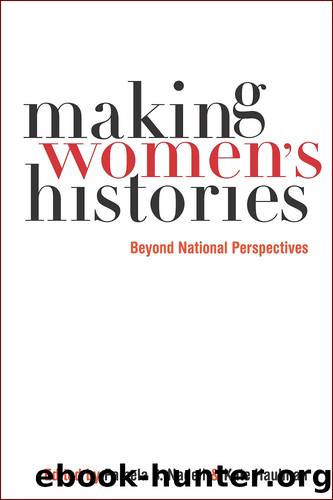
Author:Pamela S. Nadell, Kate Haulman [Pamela S. Nadell, Kate Haulman]
Language: eng
Format: epub
Tags: Nonfiction, History
ISBN: 9781351602068
Publisher: Taylor and Francis
Published: 2018-10-19T04:00:00+00:00
Domestic Dirt: The Construction of Modern Landscapes and Modern Histories
The linking of women to an emerging vision of Egypt as a distinct territory, and to the practice of modern historical narration, has its roots in the birth of Egyptâs modern state. The emergence of that state infrastructure was the result of the efforts of an Ottoman military official, Mehmet `Ali Pasha (1769â1848), who gained nominal suzerainty over the Ottoman province of Egypt by centralizing and modernizing it. To do so, he inaugurated a number of institutions which, in turn, gave rise to a cadre of civil servants who began imagining and writing about Egypt in new ways. Those state functionaries produced literature that depicted the modernization process not only as the acquisition and implementation of new governing tactics and industrial technologies by a ruler, but also as the adoption of new states of mind and the cultivation of new habits by his or her subjects. In a body of state-sponsored travel literature, history, and geography, published from the 1820s through the late nineteenth century, Egyptian civil servants ascribed the success of the state-building projects of modern rulers to the domestic habits of the men and women who inhabited their realms. Thus, as a new class of civil servants worked to modernize a territory that they referred to, with ever-increasing frequency, as distinctly Egyptian, they gestured toward women and the domestic realm as that which guaranteed (or, by contrast, inhibited) the modern nationâs success.
Mehmet Aliâs school of translation, for example, which opened in the early 1820s, produced graduates who could translate Western texts about political, economic, and military institutions (and apparatuses) into Arabic and Turkish for the use of Mehmet `Aliâs modernizing elite. The texts about accounting, medicine, civil administration, and arms building, which the graduates of the school of translation produced and published at the viceroyâs request, served as instruction manuals for the implementation of his modernization programs. At the same time, translated European history and geography books introduced a second set of instructions about modernity. Historical accounts of modern rulers, for example, Jean-Henri Castéraâs history of Catherine the Great and Voltaireâs histories of Charles XII of Sweden and Peter the Great, among others, exposed Egyptian civil servants to accounts of great men (and women) who had modernized their domains.13 In those accounts, the success of reforming monarchs was measured by such things as the reorganization of their militaries, the rationalization of their bureaucracies, and their implementation of public works. Castéra and Voltaire also attributed these rulersâ success in the public realm to their personal habits, marital practices, and domestic behaviors.
The French-German historian Georges-Bernard Depping made a similar connection between the political and the personal in his Aperçu historique sur les moeurs et coutumes des nations, in which he exposed Egyptian readers to a logic that would become common to literature produced by âbureaucrat historiansâ over the course of the nineteenth century. Depping opened his text by cataloguing nations in terms of their houses and of the customs practiced in them.
Download
This site does not store any files on its server. We only index and link to content provided by other sites. Please contact the content providers to delete copyright contents if any and email us, we'll remove relevant links or contents immediately.
| Anthropology | Archaeology |
| Philosophy | Politics & Government |
| Social Sciences | Sociology |
| Women's Studies |
Cecilia; Or, Memoirs of an Heiress — Volume 1 by Fanny Burney(32637)
The Great Music City by Andrea Baker(32610)
Cecilia; Or, Memoirs of an Heiress — Volume 2 by Fanny Burney(32011)
Cecilia; Or, Memoirs of an Heiress — Volume 3 by Fanny Burney(31997)
We're Going to Need More Wine by Gabrielle Union(19110)
All the Missing Girls by Megan Miranda(16324)
Pimp by Iceberg Slim(14668)
For the Love of Europe by Rick Steves(14582)
Bombshells: Glamour Girls of a Lifetime by Sullivan Steve(14138)
Norse Mythology by Gaiman Neil(13459)
Talking to Strangers by Malcolm Gladwell(13441)
Fifty Shades Freed by E L James(13293)
Mindhunter: Inside the FBI's Elite Serial Crime Unit by John E. Douglas & Mark Olshaker(9421)
Crazy Rich Asians by Kevin Kwan(9347)
The Lost Art of Listening by Michael P. Nichols(7549)
Enlightenment Now: The Case for Reason, Science, Humanism, and Progress by Steven Pinker(7355)
The Four Agreements by Don Miguel Ruiz(6836)
Bad Blood by John Carreyrou(6673)
Weapons of Math Destruction by Cathy O'Neil(6370)
